The situation
Virbac is an animal-health brand sold mainly through veterinary clinics, not retail shelves. Its WeChat Official Account was the brand's primary owned channel in China, and like most brand OAs it was being run as a publishing calendar: post four articles a month, hope the follower count climbs.
I owned the channel as community operations manager. Two problems made "hope" untenable. First, there was an annual net-new-follower target to hit, and the channel's single biggest acquisition event was cancelled: Pet Fair Asia, worth roughly 8K recruits in a normal year. Second, the brand had no clinic-to-OA bridge and a weak read on whether any of the activity was actually paying back. The channel needed to be treated as a performance system with a P&L, not a content schedule.
The decision
Run the OA the way you'd run a paid-media account. Every input gets a target, an actual, a completion %, and a named competitor as the benchmark, and then you keep only what compounds. Concretely:
- Replace the cancelled trade fair with a built channel: a gamified H5 acquisition engine, measured on incrementality (what we'd have gotten without it), not gross adds.
- Buy KOLs on efficiency, not fame. Rank every paid placement by CPM and sequence the buys, instead of paying for the biggest follower counts.
- Score content on engagement × conversion: a matrix that tells me which content types to make more of, not just which post did well last week.
- Treat product packaging as owned media. Make the anti-fake QR sticker an always-on acquisition surface, not just a verification stamp.
The strategy
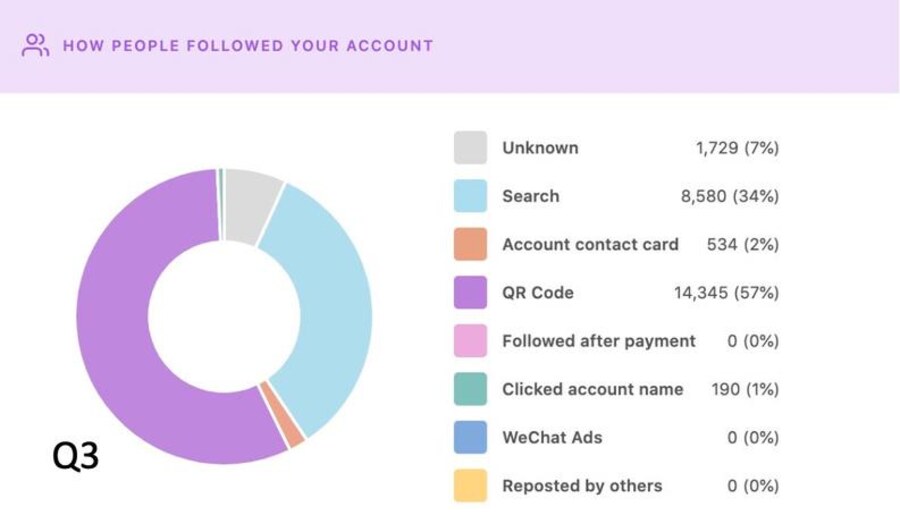
Packaging as media. For a clinic-sold brand, the product box reaches the owner at the highest-intent moment, right after purchase. I designed the anti-fake QR scan as an acquisition surface, and it became the single largest source of follower growth: roughly two-thirds of new followers came through the sticker. That is free, always-on media that no competitor was exploiting at the same level.
SEO as the second engine. I bet that WeChat in-ecosystem search was an under-used acquisition path and invested deliberately in discoverability. The source mix validated the bet: organic search roughly doubled as a share of new followers across two quarters. Two engines, packaging and search, gave the channel a base that didn't depend on any single campaign.
The H5, run as an incrementality test. When Pet Fair Asia was cancelled, I built a hygiene-themed H5 game to replace it (pick cat or dog → enter a 3D room → eyes/ears/mouth/skin care modules → check-in, watch a product video, share to enter a lucky draw). The point wasn't the game; it was the measurement frame. I forecast the follower line without the H5 and held the campaign to the gap, not the headline number.
CPM-ranked, wave-sequenced paid KOL. I bought a portfolio of pet-focused WeChat accounts and ranked every placement by CPM. The pattern held: mid-tier accounts beat the mega accounts on cost per outcome, sometimes by ~3x. I sequenced the buys in waves, syndicated awareness first, then original unboxing content, then event-timed posts, then a gift-box conversion push, each wave timed to the H5 and to the follower curve.
A content-scoring matrix. Instead of ranking posts by raw reads, I scored content types on engagement and conversion together, then reallocated the calendar toward what scored. The matrix surfaced uncomfortable truths I acted on. Seasonal and holiday posts had crept to ~45% of output and were measurably suppressing shares, so I cut them back toward the science-led and interactive formats that out-read promo content.
This is the compounding part: each quarter's read fed the next quarter's plan. Q2 informed Q3, the H5 result reset the acquisition baseline, and the scoring matrix kept lifting return quarter on quarter.
Execution
- Monthly + quarterly P&L reporting. Every cycle reported as goal → actual → completion % → time-elapsed %, with reads benchmarked against a named competitor (Elanco) rather than an arbitrary number. The skeleton made the channel accountable and made trade-offs legible to commercial leadership.
- H5 build and run, 52 days (late Aug–late Oct 2021). 3D-room game with a mission loop (registration, product video, share-to-enter). Launch and three paid-post waves timed against the follower chart.
- 10-account paid KOL program. Each placement logged with followers, reads, impressions, interactions, and CPM; CPM used as the ranking and renewal signal.
- Content matrix maintained per cycle. Share-to-Moments ratio and share destination tracked as content-quality KPIs, not just read volume, so quality decay couldn't hide behind a healthy reach number.
- Competitive intel as a standing section. I tracked Boehringer Ingelheim's sCRM / mini-program build (provider, SKU coverage, partnership structure) quarterly, so the channel strategy was set against where the category was moving.
Result
- 122% of the net-new-follower target in the benchmark month (actual 2,871 vs 2,350 goal); the channel held its plan and finished the year on track for the annual goal without the cancelled trade fair.
- #3 in the category by reads, ahead of Boehringer Ingelheim and Elanco and behind only the two category giants, achieved on a fraction of their media budget.
- H5: +115% in daily new-follower rate; 10,666 recruits in 52 days, against a forecast-without-H5 baseline. That is the incrementality, not a gross vanity number. It fully replaced the cancelled trade fair as the acquisition engine.
- +15–18% QoQ ROI from the content-scoring matrix as the calendar shifted toward higher-scoring formats.
- CPM-ranked paid KOL confirmed the thesis: mid-tier accounts beat mega accounts on cost per outcome, which changed how budget was allocated in later waves.
Underneath those headlines sat a real network: 280+ KOLs across roughly 11.2M reach in the wider seeding program, plus a steady ~+25% lift in content engagement as the matrix took hold.
What this demonstrates
Performance reviews, data-backed insights, and organic account growth: the discipline a premium foreign brand needs on its owned channels, applied here for two years.
Performance reviews as a system, not a slide. Goal → actual → completion % → time-elapsed %, every cycle, benchmarked against a named competitor. That's the reporting cadence to install on every account.
Data-backed insights that changed the spend. CPM ranking moved budget from mega to mid-tier KOLs; the content matrix cut over-indexed seasonal posts; source-mix data validated the SEO bet. Insights here meant reallocation, not commentary.
Organic growth designed, not wished for. Two-thirds of acquisition came from a physical touchpoint (the anti-fake QR) I deliberately turned into media, plus a doubling of organic search share. That is owned, compounding growth, the cheapest kind there is.
The Owner mindset. When the biggest acquisition event was cancelled, I didn't report a shortfall. I built the replacement channel, measured it on incrementality, and beat the plan anyway. That is how I'd run a client's account: treat their numbers as my P&L, and make the channel pay back quarter on quarter.